Crochet Lacy Flower Bandana Scarf
The Most Elegant Crochet Bandana You Will Ever Make — Pineapple Lace Head Scarf
Some crochet projects are beautiful. And then there are projects like this one — projects that make people genuinely stop and stare, lean in closer, and ask in disbelief whether it is really handmade. The Lacy Flower Bandana Scarf is that kind of project.
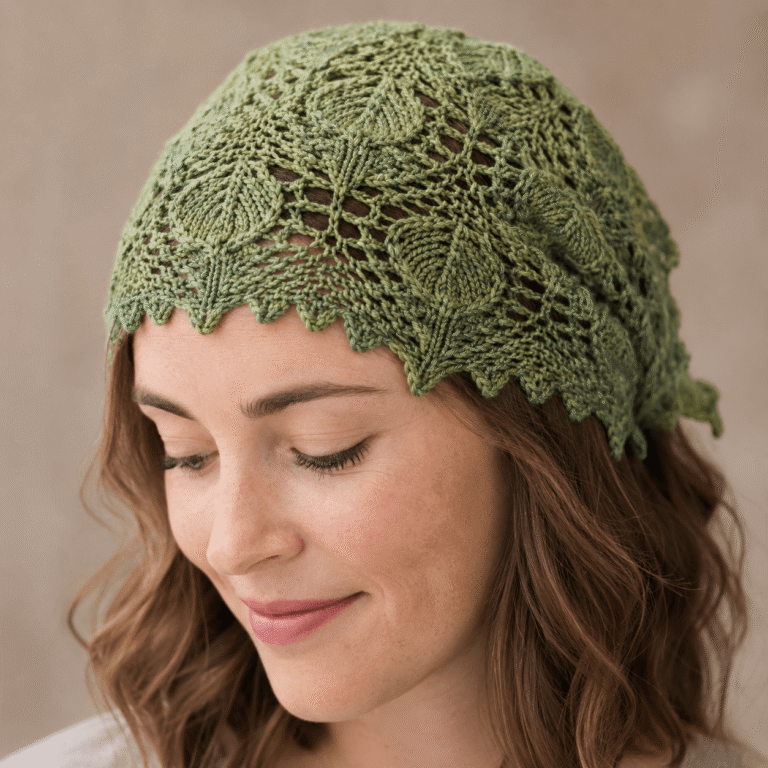
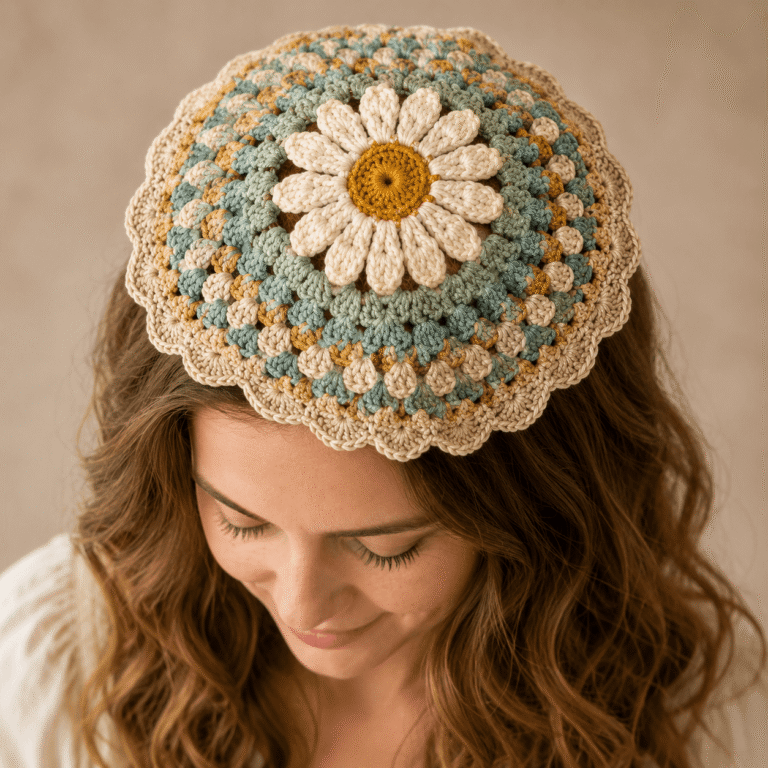
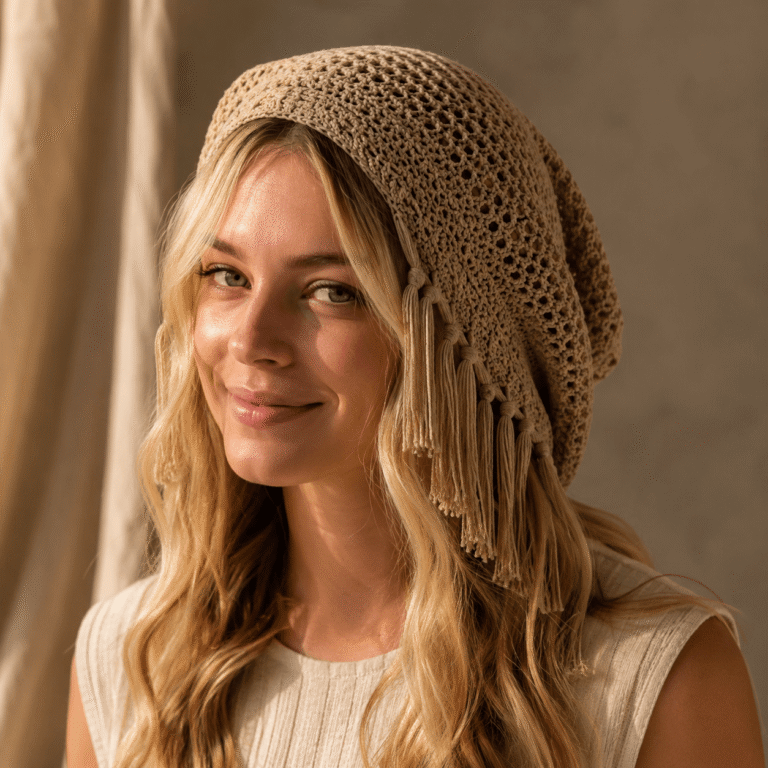
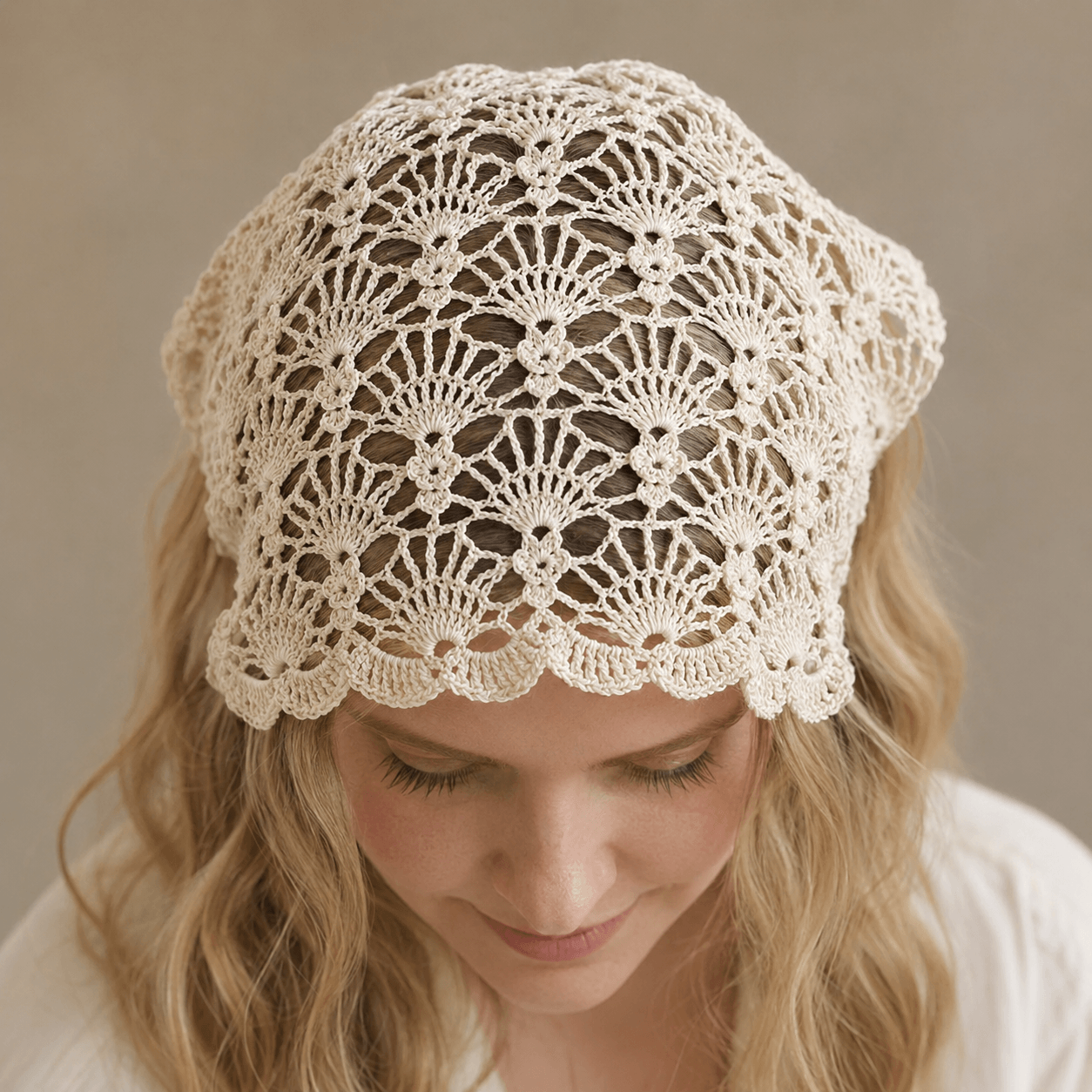
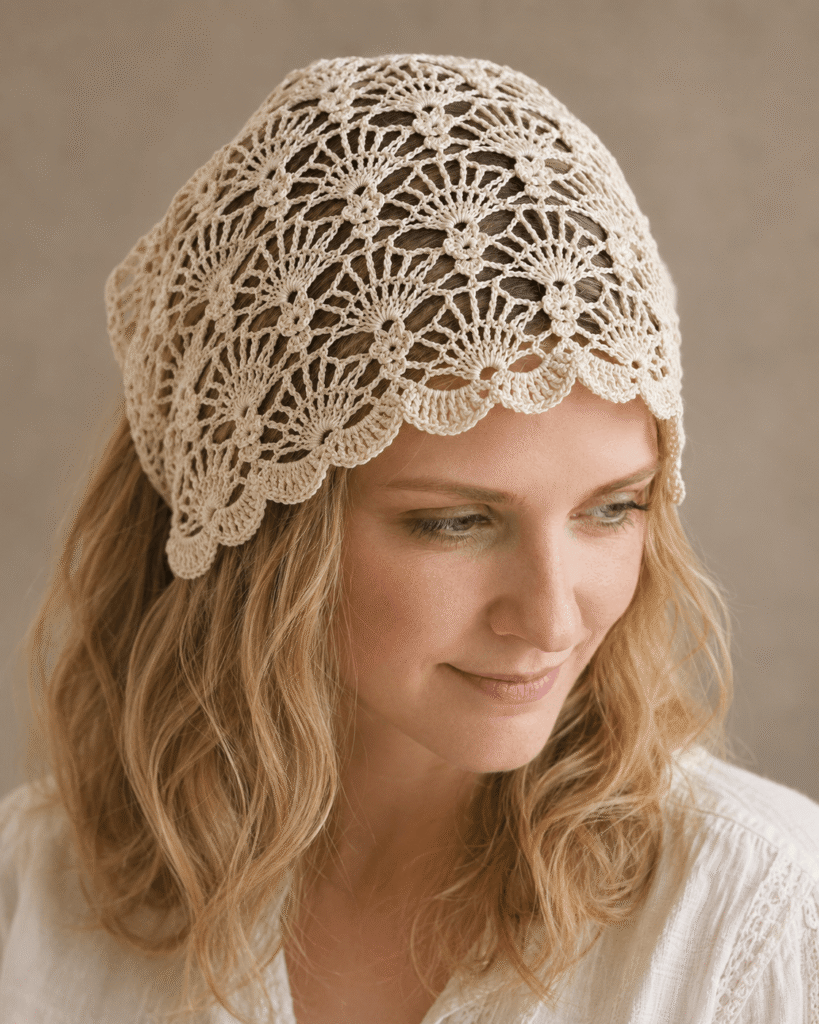
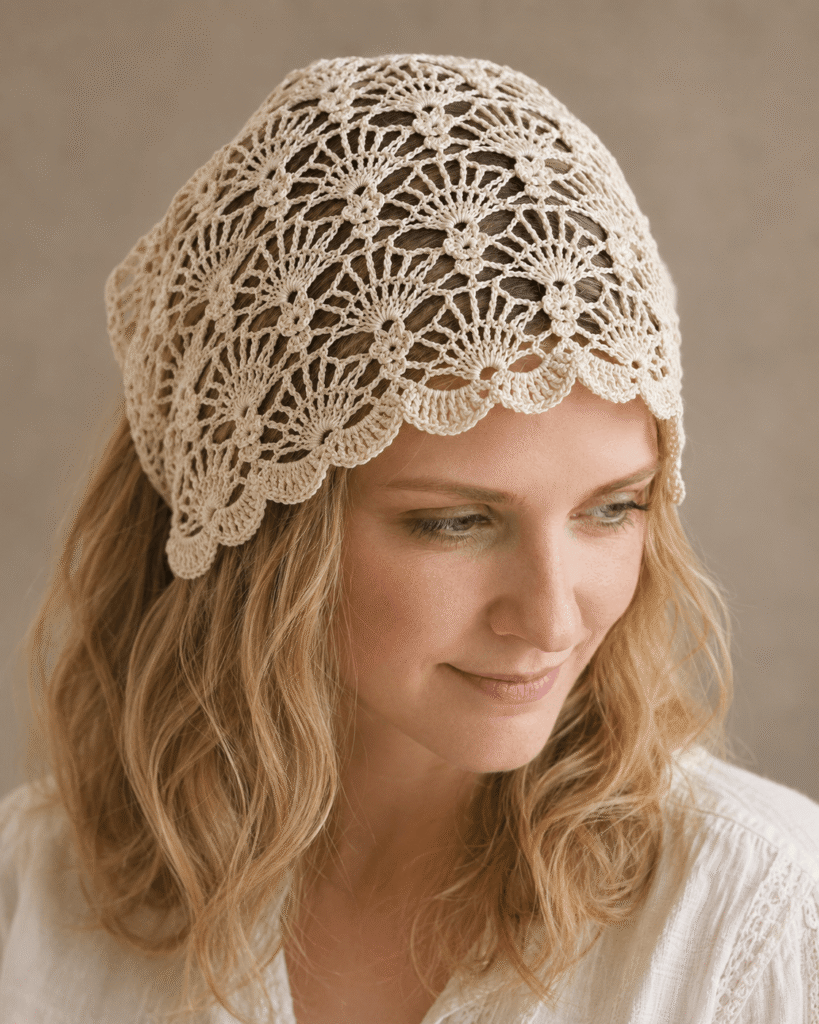
Worked in fine Natural Linen / Warm Ecru mercerized cotton thread on a small steel hook, this bandana features a breathtaking repeating pineapple fan lace pattern with delicate flower centers at every motif junction, an open chain-mesh interior that reveals the hair beneath in the most romantic way imaginable, and a sweeping scalloped fan border that ripples along the forehead edge like something from a Victorian lace collection.
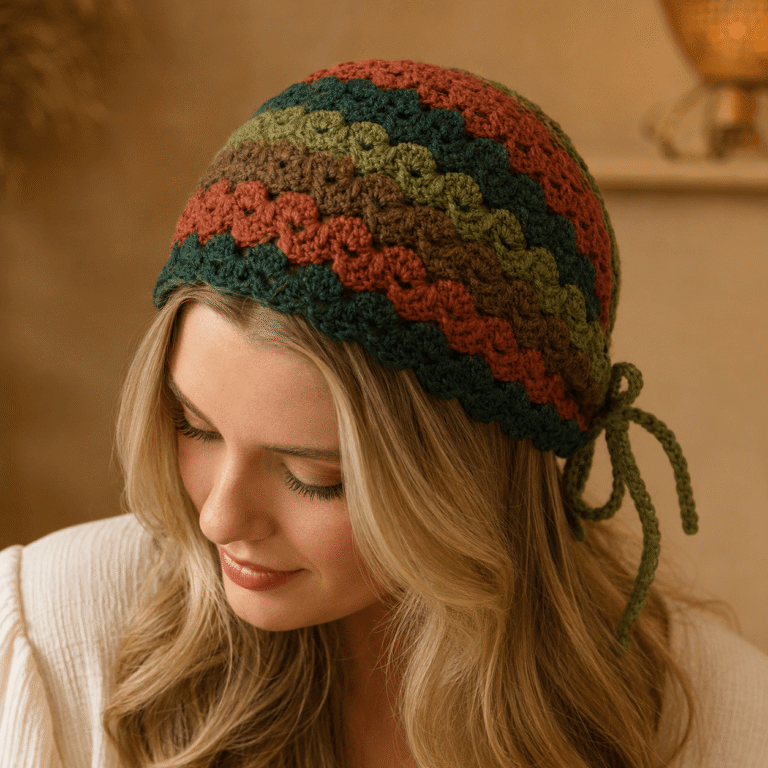
Worn draped over the head with the lace hem framing the face and the sides flowing back to tie at the nape of the neck, this bandana is equally at home as a bridal hair accessory, a cottagecore festival piece, a grandmother’s gift, or simply the most beautiful thing you have ever made for yourself.
This is an advanced pattern — fine thread lace crochet is genuinely different from working with yarn, and the pineapple lace motif requires careful attention to the pattern sequence. But every advanced crocheter who takes this on will create something they treasure for the rest of their lives.
Frequently Asked Questions
Is this lace bandana pattern suitable for beginners?
This pattern is rated advanced, and that rating is honest. Fine thread lace crochet requires a comfort level with very small hook sizes, thread-weight yarn, reading multi-step lace pattern rows, and a patience for slow, careful work where every stitch is visible. If you have never worked with crochet thread before, this is not the place to start — but if you have made lace doilies, thread dishcloths, or any fine-gauge crochet before, you have the foundational skills this pattern builds on. The pineapple motif specifically has a learning curve of approximately one to two full repeats before it becomes comfortable. After that, it is deeply rhythmic and meditative.
What thread works best for this bandana?
Mercerized cotton thread is the gold standard for heirloom lace crochet. Mercerization is a treatment process that gives cotton thread a subtle sheen, increased strength, and improved stitch definition — all of which are essential when the entire beauty of your project is in the lace architecture. Size 10 crochet thread (fingering weight) in a Natural, Ecru, or Linen colorway is ideal. Excellent brands include Aunt Lydia’s Classic Crochet Thread in Natural, DMC Traditions Crochet Thread in Ecru, or Lizbeth Size 10 in Ecru. Avoid any thread that is fuzzy or textured — fuzz is the enemy of lace definition.
How long does this bandana take to complete?
Most advanced crocheters complete this bandana in 12 to 18 hours of focused working time. Fine thread lace is inherently slower than yarn work — the hook is small, the stitches are tiny, and precision matters in a way it simply does not in worsted weight projects. The pineapple motif rows take approximately 30 to 45 minutes each once learned. Plan for a multi-week project worked in comfortable, focused sessions rather than marathon sittings. Your eyes and hands will thank you.
What size will the finished bandana be?
The finished Lacy Flower Bandana measures approximately 20 to 22 inches across the top straight edge and 13 to 14 inches deep at the center point. This creates a generously sized triangle bandana with excellent coverage and long enough tie ends to wrap comfortably around the head and tie at the nape of the neck. The size can be adjusted — work fewer decrease rows for a shallower bandana, or add extra rows of the lace pattern before beginning decreases for a deeper one.
Does fine thread lace crochet need to be blocked?
Blocking fine thread lace is not optional — it is transformational. A finished piece of thread lace before blocking is a fraction of its eventual beauty. The pineapple fan motifs are compressed and the chain mesh spaces are closed. After wet blocking and pinning, every pineapple opens dramatically, every chain space breathes fully, and the scalloped fan border fans out into its complete, breathtaking shape. Block this bandana generously and firmly. The result is a completely different — and far more spectacular — piece than the one you unpinned from the blocking mat.
Materials Needed
The following materials will give you the finest, most beautiful version of this heirloom lace bandana.
Thread / Yarn:
- Main Color (MC): Natural Linen / Warm Ecru Size 10 mercerized cotton crochet thread — approximately 400–500 yards. A single ball of Size 10 crochet thread typically contains 350 to 400 yards; have two balls on hand. Aunt Lydia’s Classic Size 10 in Natural (Article 154), DMC Traditions in Ecru, or Lizbeth Size 10 in Ecru are all ideal. The warm Ecru / Natural tone — not bright white — is essential for the vintage, heirloom aesthetic of the reference image.
Tools and Notions:
- 1.75 mm or 2.0 mm steel crochet hook — a quality steel hook is important for thread lace work; the smooth, precise tip makes inserting into tiny chain spaces much easier. Susan Bates Silvalume or Clover steel hooks are excellent choices.
- Scissors — small, sharp embroidery scissors are ideal for clean thread cuts
- Tapestry needle / darning needle — with a fine eye suitable for thread-weight yarn, for weaving in all ends
- Stitch markers — fine locking markers or bobby pins work well for marking pattern repeats in thread work
- Blocking mat — a large interlocking foam mat is ideal; you need enough surface to pin the full 20 × 14 inch triangle
- Rust-proof T-pins — essential; standard straight pins may rust if left in damp cotton thread
- Spray bottle — for wet-spray blocking
- Measuring tape
Why mercerized cotton? The sheen of mercerized cotton is what gives fine lace crochet its characteristic luminous quality — the way the thread catches and reflects light slightly differently in each chain space and cluster. This sheen is not achievable with unmercerized or matte thread. For a piece as intricate and visible as this bandana, only mercerized cotton does the lace architecture justice.
Skill Level
Skill Level: Advanced Stitches Used: Chain (ch), Slip stitch (sl st), Single crochet (sc), Double crochet (dc), Treble crochet (tr), Double treble crochet (dtr), Chain spaces (ch-sp), Pineapple / fan lace motif (detailed below), Flower join motif, Scalloped fan border Estimated Time: 12–18 hours Finished Dimensions: Approximately 20–22 inches wide × 13–14 inches deep at center triangle point
Step-by-Step Tutorial
Step 1: Understand the Pineapple Lace Motif — Swatch First
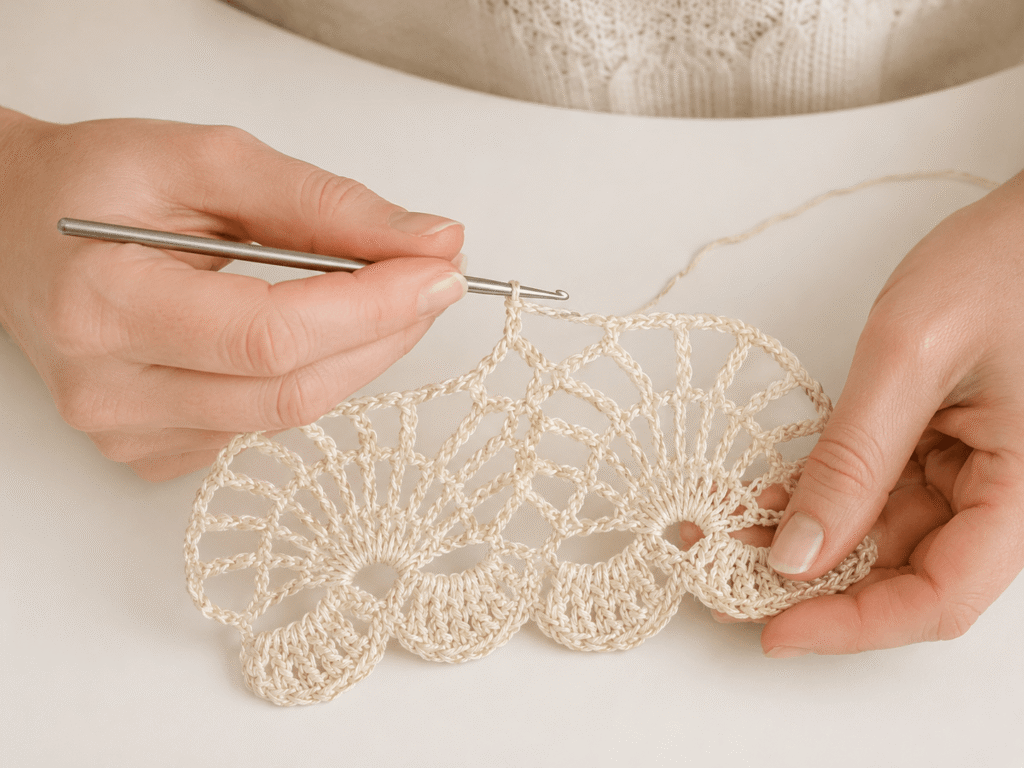
Before casting on the bandana, work a practice swatch of the pineapple fan lace motif. This is non-negotiable for any crocheter new to pineapple lace — even experienced crocheters benefit from 30 minutes of practice on a small swatch to internalize the pattern rhythm before working on the actual piece.
What is a pineapple motif? The pineapple motif is a classic heirloom lace structure built on a fan of decreasing double crochet or treble crochet stitches worked into chain spaces that narrow row by row, creating a pointed teardrop / pineapple shape. Each pineapple begins wide at the base and narrows to a single stitch at the top. Between each pineapple, open chain-mesh spaces create the airy, breathable lattice you see throughout the interior of the bandana.
Practice swatch foundation: Using your Natural Ecru thread and 2.0 mm hook, chain 36. Row 1: Dc in 6th ch from hook, *ch 2, skip 2, dc* across. (Foundation mesh row) Row 2: Ch 5, turn, dc in first ch-2 sp, *ch 2, (dc, ch 2, dc, ch 2, dc, ch 2, dc, ch 2, dc) into the center mesh space — this 5-dc fan is the base of one pineapple, ch 2, dc into next sp* repeat. Row 3: Ch 5, turn, *work (ch 2, dc) into each ch-2 space within the pineapple fan, narrowing by one dc cluster at each end* across.
Continue working pineapple rows, narrowing by one dc on each side of each fan per row, until each pineapple ends in a single dc at the tip. Practice until the rhythm is clear and comfortable before beginning the full bandana.
Step 2: Work the Foundation and First Lace Rows
The Lacy Flower Bandana is worked from the top straight edge downward, with lace rows building downward and the piece tapering to a center point at the bottom hem.
Using Natural Ecru thread and your 2.0 mm hook, chain 181 (or a multiple that accommodates your chosen number of pineapple repeats — each pineapple requires approximately 18 to 20 foundation chains). Adjust as needed for your tension and desired width.
Setup Row: Dc in 6th ch from hook, *ch 2, skip 2 ch, dc in next ch* across. This creates the foundation mesh row — a simple chain-2 mesh that is the structural base for the entire lace pattern. Chain 5, turn.
Row 1 (Pineapple base row): Work the wide fan base of each pineapple motif across the full foundation mesh, placing each fan into alternating mesh spaces and leaving open chain mesh spaces between each fan. Join neighboring fan bases with a small (sc, ch 3, sc) flower join at every alternate mesh space — this creates the small flower centers visible at every motif junction in the reference image.
Step 3: Build the Pineapple Motif Rows
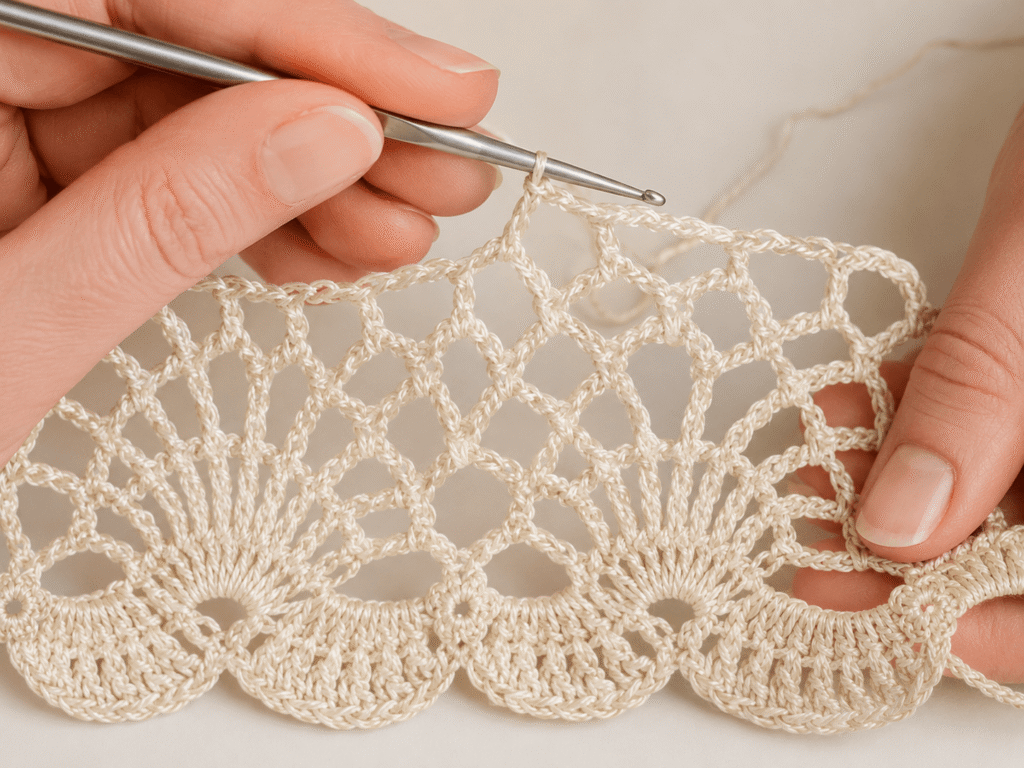
Work the full pineapple motif pattern row by row, narrowing each fan by one dc cluster per side on every right-side row. The chain mesh spaces between pineapples remain constant throughout, preserving the open lattice structure.
Right-side rows: Work the decreasing pineapple fan into each pineapple’s chain spaces, narrowing inward. Work (dc, ch 2) into each chain space within each fan. Between fans, work the chain mesh bridges.
Wrong-side rows (turning rows): Ch 5, turn. Work dc into each chain-2 space across, maintaining the chain-2 mesh structure. These are the simpler rows that give your hands a brief rest between the more complex pineapple rows.
Continue alternating pineapple rows and mesh rows until each pineapple narrows to its tip — a single dc or sc into the final chain space of the pineapple. Each completed pineapple produces approximately 6 to 8 rows from base to tip.
As the pineapples complete their points, new smaller pineapples begin in the spaces between the completed ones — this nesting structure is what creates the all-over lace texture visible across the entire surface of the bandana.
Step 4: Work Triangle Shaping Decreases
Beginning after the first complete set of pineapple motifs, introduce gradual decreases at both ends of every pattern row to create the triangular bandana shape.
Decrease method: At the beginning of each decrease row, slip stitch across the first 3 chain spaces before beginning the pattern. At the end of the same row, leave the last 3 chain spaces unworked and turn. This removes approximately one pineapple motif from each side over every full motif height, creating the clean angled edges of the bandana triangle.
Continue the full pineapple lace pattern with end decreases, working from the outer edges inward, until a single pineapple motif or a narrow lace section remains at the center point. Work the final motif to its tip point and fasten off, leaving a 6-inch tail.
Check your work from the front after every two to three rows. The lace should be laying flat, the pineapple points should be crisp, and the chain mesh spaces should be even and consistent.
Step 5: Work the Scalloped Fan Border
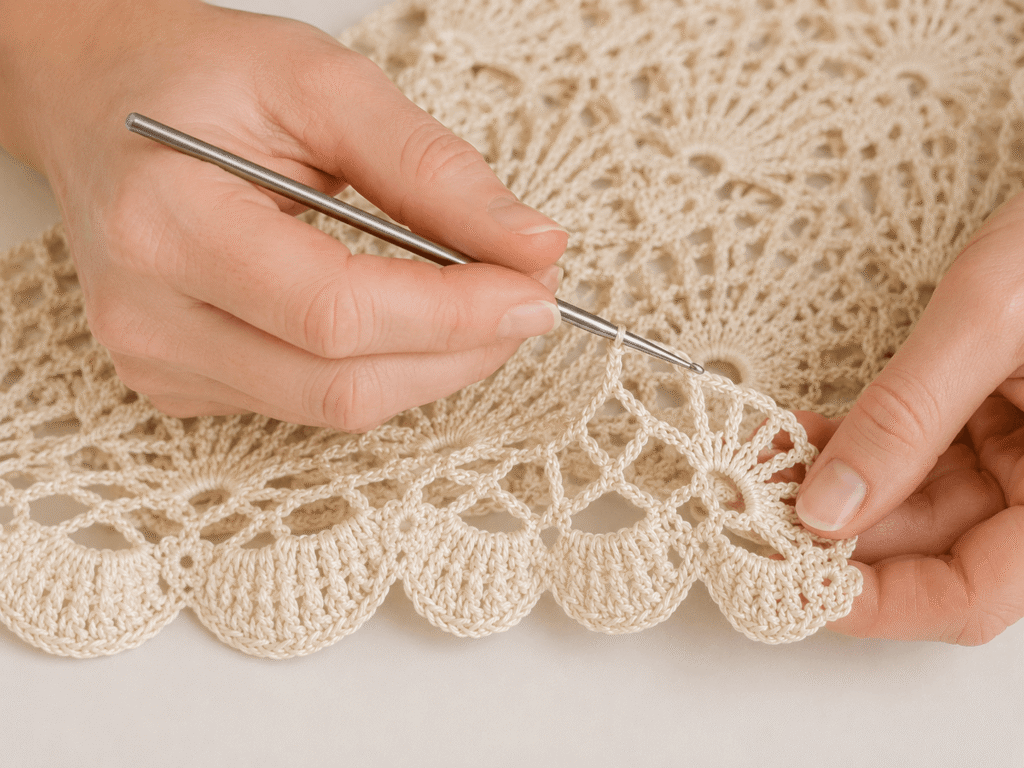
The scalloped fan border is the crowning glory of this bandana — the sweeping, deeply scalloped lower hem edge that makes this piece look like a fragment of Victorian needle lace. It runs along both angled side edges and across the lower hem edge of the triangle.
Attach Natural Ecru thread at the right-hand corner of the top edge. Work a foundation row of sc evenly along both side edges and the lower point, working into every available chain space and dc post. At the center bottom point, work 3 sc into the point to turn cleanly.
Scalloped fan border round: *Skip 2 sc, work (3 dc, ch 2, 3 dc, ch 2, 3 dc) fan shell into the next sc, skip 2 sc, sc into the following sc* repeat all the way around both side edges and the full lower hem. At corners, work 2 fan shells to turn without puckering.
Second border round — fan tops: Work (sc, 3 dc, ch 2, 3 dc, ch 2, 3 dc, sc) into each ch-2 space of each fan shell, and sc between fans. This deepens and fills each fan scallop into the full, open, deeply scalloped border visible in the reference image.
Fasten off and weave in all ends.
Step 6: Block Thoroughly and Add Tie Extensions
Blocking — the essential final step: Submerge the finished bandana in cool water for 15 minutes. Gently squeeze — never wring — the water out. Lay flat on your blocking mat. Using rust-proof T-pins, pin the top straight edge first across its full width. Then pin the two angled side edges, stretching them gently outward. Finally — and most importantly — pin every single scallop point of the fan border individually along the hem edge, pulling each fan open to its full width and depth. The difference between pinned and unpinned fan scallops is dramatic.
Allow to dry completely flat — 24 hours minimum for cotton thread. Once removed from pins, the pineapple motifs will be open and airy, the chain mesh will breathe fully, and the fan border will be deeply, precisely scalloped.
Tie extensions: At the two top corners, attach Natural Ecru thread and chain 55 to 60 for each tie. Work 2 rows of sc back across the chain. Fasten off and weave in ends. The finished ties should be approximately 10 to 11 inches long — enough to wrap comfortably and tie at the nape of the neck.
Helpful Tips
- Work in short, focused sessions. Fine thread lace demands your full visual and mental attention. Two focused hours produce better results — and are more enjoyable — than six tired, distracted hours. Stop when your eyes are strained. The work will still be there tomorrow and it will be better for your rest.
- Use a thread stand or yarn bowl. Fine crochet thread tangles and twists more easily than yarn. A thread stand or a small yarn bowl keeps your thread feeding smoothly and prevents the constant untwisting that can make thread work frustrating.
- Count chain spaces — not stitches — when checking your work. In lace crochet, the chain spaces are the structural element that everything hangs on. Counting chain spaces at the end of every row is faster and more meaningful than counting individual stitches, and will catch errors before they compound.
- Use good lighting — always. This is not a project for dim rooms or candlelight aesthetics. Natural daylight or a strong daylight-balanced craft lamp is essential for seeing the tiny chain spaces of Size 10 thread clearly. Eye strain is the enemy of both accuracy and enjoyment in fine lace work.
- Pin every single scallop point during blocking. Each fan scallop on the border needs its own pin to open fully. A scallop that is not pinned will not open — it will stay as a compressed arch. Take the time to pin every point, every fan, every motif tip along the hem. The result is worth every pin.
Common Mistakes to Avoid
- Working the pineapple fan into the wrong chain space. The pineapple motif requires inserting into specific chain spaces in a precise sequence. Working into the wrong space — especially on the decreasing rows — collapses the motif shape. Read each row carefully and confirm your insertion point before making the stitch.
- Inconsistent tension between chain mesh rows and pineapple rows. Many crocheters work their chain mesh rows at a different tension from their fan rows. Consciously maintain even, relaxed tension throughout, especially in the chain-2 mesh bridges between pineapples — too tight and the mesh closes up; too loose and the fabric loses structure.
- Skipping the practice swatch. The pineapple lace motif is not intuitive on first encounter. Attempting the full bandana without first practicing the motif on a small swatch is the single most common mistake advanced crocheters make with this pattern. The 30-minute practice investment prevents hours of frogging later.
- Insufficient blocking. A timidly blocked lace bandana — too few pins, not enough stretch, removed from the mat before fully dry — will bounce back toward its unblocked shape. Block generously. Use more pins than you think you need. Leave it on the mat for a full 24 hours. There is no such thing as over-blocking mercerized cotton lace.
- Cutting thread tails too short. In Size 10 thread, a tail of less than 4 to 5 inches is genuinely difficult to weave in securely — the thread is fine enough that very short tails can pull free with wear or washing. Always leave at least 5 to 6 inches when fastening off.
Final Thoughts
The Lacy Flower Bandana Scarf is the kind of project that changes how you see your own crochet practice. Making it teaches you that you are capable of producing something truly heirloom-quality — something that could sit alongside vintage lace in an antique shop and not look out of place.
It is not the fastest project in your queue. It will ask patience and focus from you. But the morning you remove it from the blocking mat, hold it up to the light, and see every pineapple fan open and every scallop pointing perfectly — that morning, you will understand exactly why lace crocheters have been making things like this for two hundred years.
It is a form of making that is also a form of devotion.
Save This Pattern For Later
Captivated by this Lacy Flower Bandana? Pin it to your Crochet Lace Patterns or Heirloom Crochet board on Pinterest right now — this is the kind of pattern you will want to find again when you are ready for your next beautiful challenge. Share it with every advanced crocheter you know who is looking for a project worthy of their skill.